
Brakes
The importance of skimming brake rotors and when it should be done.
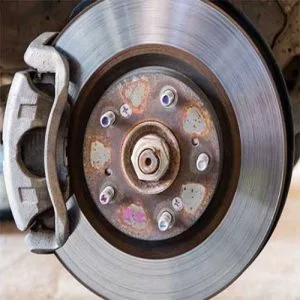
Machining the hubs (skimming brake rotors) is not the only factor in determining a car's performance, the engine's power and speed aren't the only standards. Consideration must be given to many other factors, the brakes' strength being a prime example. The faster the speed, the more the need for stronger brakes.
ما هي الهوبات وما أهميتها
The braking mechanism relies on the friction forces that arise between the brake pads and other tools known as rotors. As a result of continuous friction during most driving times, parts of these rotors become thinner, which affects their performance. In this case, either the rotor must be replaced, or it needs to be resurfaced and treated through a process known as rotor machining, using a specific tool usually found in a lathe. It is not advisable to carry out this operation with a grinder, as rotor machining requires great precision and manual use of the grinder certainly won't provide the necessary accuracy.
Types of Hubs
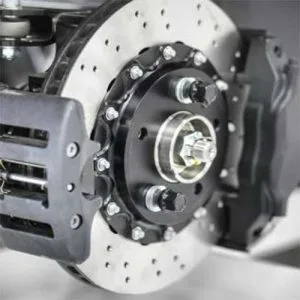
There are 5 types of hubs that vary from each other in terms of appearance and some of their features, these types are:
- Smooth hubs This type of hub is considered the best for heat dissipation due to the heat-absorbing properties of the materials it is made from, in addition to having a large surface area that increases friction with the brake lining.
- Drilled rotors It is considered the best option for cars located in damp areas, as it contains holes spread over its entire surface. These holes allow the passage of water, heat, and dust with ease, which increases the braking power in those damp areas.
- Slotted rotors This type of hub is used in trucks and four-wheel-drive cars, due to its good braking ability. There are slots on its surface that attract a larger amount of air between the brake lining and the hub surface, which improves cooling and heat dissipation. Its most prominent drawback is that it reduces the life of the lining and accelerates its wear.
- Slotted and drilled rotors. It is used in cars that require very high braking power, such as sports cars.
- The floating hubs floated. It consists of an outer surface that comes into contact with the brake lining, and a cap that is fixed on the wheel axle, its temperature does not rise when using the brakes, unlike the outer surface.
Also read:The importance of the engine seal and when it should be changed.
How do you know if the hub needs machining?
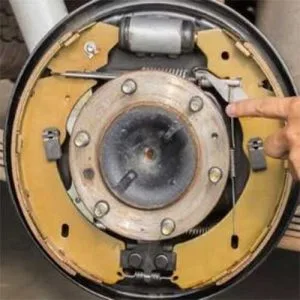
Many people may wonder when they should turn the rotors. To answer this question, this section highlights all the cases in which a person would need to turn the rotors.
- When the hub is deformed Most often, friction between the rotors and brake pads causes the pads to warp and wear. Therefore, you may need to replace brake pads periodically. However, warping the rotors is not necessarily a regular occurrence, it's possible for a car to travel a total distance of up to 150 thousand kilometers without the rotor suffering any problems. This depends on the type of pads used and the driver's driving style. Thus, when replacing worn brake pads, it is important to check whether or not the rotors are damaged because a damaged rotor that needs turning can significantly shorten the pads' lifespan and negatively affect their performance.
- The occurrence of a shake when pressing on the brakes. The vibration of the car when pressing the brakes is one of the most important indicators of hub damage. The vibration results from uneven thickness of different parts of the hub. This occurs when only some parts of the hub surface wear away, while others remain intact, creating a variance in thickness. It is not necessary for this thickness difference to be significant for vibration to occur. It could be so small that it's imperceptible to the human eye. Typically, vibrations start when the hub surface thickness varies by 0.001 inches and gradually gets worse over time. Therefore, it is necessary to check the hub with a precise tool, like a micrometer, to diagnose its condition. However, it’s essential to note that resurfacing the hubs leads to a reduction in their thickness, which affects their ability to dissipate high temperatures. As a result, temperatures will rise, reducing the lifespan of the engine's brake pads. So, you may need to replace them regularly. Not only that, but it will also affect the stopping distance - the distance the car travels from the moment you press the brakes until the car comes to a complete stop. The thinner the hub, the greater the stopping distance, which is not ideal and increases the likelihood of traffic accidents.
How many times can skimming brake rotors be done?
Many people may wonder about the permissible number of times for car maintenance and repair.Turn the brake rotors.Especially since this process has negative effects, as mentioned in the previous paragraph, generally, resurfacing the rotors is allowed a number of times not exceeding 3 times, as there is a certain thickness that should not be reduced below its minimum limit. Exceeding this limit poses a significant risk to the passengers and the engine's brake pads, as the braking power will significantly decrease. For this reason, if the rotor's thickness reaches its minimum limit, it is advisable to replace it immediately. Usually, the minimum limit for the thickness of the front rotors is estimated at 21.4 mm, while the minimum limit for the thickness of the rear rotors is about 8.4 mm.
Frequently asked questions
How many times can brake rotors be skimmed?
Skimming brake rotors is allowed no more than 3 times, because each rotor has a minimum thickness it must not go below. If a rotor reaches that minimum, it is advisable to replace it immediately.
Can I skim brake rotors with a grinder?
It is not advisable, because rotor machining needs great precision that a hand-held grinder cannot give. Skimming is done with a specific tool usually found in a lathe.
How do I know if my rotor needs skimming?
One of the main signs is the car shaking when you press the brakes, caused by uneven rotor thickness. The vibration usually starts at a 0.001 inch difference, so the rotor is checked with a precise tool such as a micrometer.
What is the minimum brake rotor thickness?
Usually, the minimum thickness of front rotors is estimated at 21.4 mm, while the minimum for rear rotors is about 8.4 mm.
Does skimming brake rotors have downsides?
Yes. Skimming reduces rotor thickness, which weakens heat dissipation and shortens brake pad life. The stopping distance also grows as the rotor gets thinner.
Related articles
 Brakes
EPB: How Electronic Parking Brakes Improve Safety
Learn how the Electronic Parking Brake (EPB) helps reduce skidding and sudden accidents on wet roads and sharp bends, plus its advantages and disadvantages.
4 min read Brakes
6 Signs Indicating Brake Oil Damage
Learn how brake oil supports your car’s braking system and discover six signs that indicate damage, helping you maintain efficient braking and control.
4 min read Brakes
5 Reasons That Lead to the Brake Light Appearing on the Dashboard
Learn why the brake light appears on your dashboard, including low brake fluid and worn linings, and how to identify and fix the problem.
4 min read