
Suspension
4 Symptoms Indicating Damage to the Car's Scissors
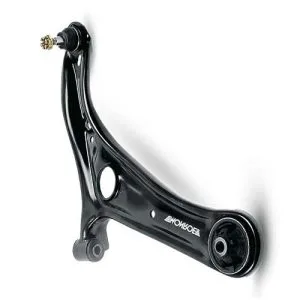
Car scissors (control arms) are metal arms that link the wheels to the car's body and keep it stable and balanced while you drive. Damage usually shows as four symptoms: uneven tire wear, steering wheel vibration, an unstable car, and annoying noises from underneath.
What are the car scissors?
Car scissors are a very important component of the car, as they play a crucial role by linking the wheel axle to the car chassis. They play a key role in maintaining the stability and balance of the car while driving. They are found in economy cars that only have front-wheel drive and lower scissors, while most four-wheel-drive and rear-wheel drive cars usually have both upper and lower scissors.
What constitutes the car's scissors and what do they look like?
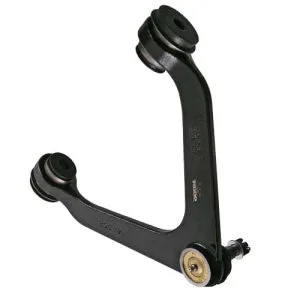
The car's scissors are composed of an iron body shaped like the letter A or Y, and at each end, there is a pair of bushings made either of rubber or polyurethane. These bushings are attached to the car's frame and play an important role in reducing vibrations caused by the car's tires. In addition, they contribute to maintaining the car's balance. When these bushings are damaged, friction occurs between the scissors and the car's frame, causing an increase in vibrations and discomfort while driving, in addition to some other potential problems.
On the other end, there's the car's ball joint that connects with the car's wheel hub. This ball joint is a spherical linkage, which plays an important role by allowing the suspension components in the car to move in all directions, whether it's moving up and down, or moving from side to side with a 360-degree rotation.
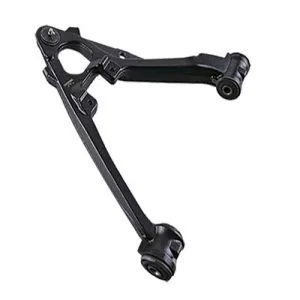
Some cars may have different types of scissors jacks, appearing as several interconnected arms. However, they resemble the previous type of scissors jacks in that there is leather at their ends, and at the opposite end, there is a joint. In addition, it should be noted that most cars have rear scissors jacks, which are often two, three, or four iron arms. Each end may carry a rubber strap, or one end may have a rubber strap and the other end a joint.
Also read:5 Signs Indicating Damage to the Control Arm Bushings
Symptoms of Car Suspension Damage
Since every part in a car has a role and function it performs, there will undoubtedly be an indicator and a guide when it is damaged. The top 4 symptoms and indicators of car scissors damage are:
- Uneven tire wear
Damage to the control arm bushing or the control arm joint can negatively affect the tires, causing them to wear unevenly. This might result in the inner edges of the tire, or the outer edges, wearing down, but they will not wear down evenly. However, it's important to remember that if you notice wear on your tires, it doesn't necessarily mean that the control arms are the cause. There could be a number of potential causes for this wear, such as an increase in load, luggage, passengers, overinflated tires, or poor tire alignment.
- Steering wheel vibration
This indicator is perhaps one of the most significant signs indicating the beginning of car scissors damage. Over time, these vibrations may increase to an unbearable extent and can be noticed when the car accelerates, as the severity of the vibrations then increases even more.
- Lack of vehicle stability
The primary function of a car's control arm is to ensure the balance of the car. Therefore, damage to the control arms can cause the car to lose its balance while driving. Control arms perform their function by securing balance through the bushings, which allow the control arm to move in a limited manner upward and downward only. Unfortunately, if there is a defect in the bushing, the control arm is enabled to move in all directions, which can cause the car to lose its balance.
- Annoying noises coming from underneath the car.
In addition to the cracks that occur in the car tires at the end of the life expectancy of the suspension systems, you will also hear annoying noises coming from under the car. The source of these sounds is the friction happening between the metal parts of the suspension. Moreover, you can hear these friction noises more when driving in areas full of potholes, bumps, or when using the brakes forcefully.
Look after the shock absorbers too: they are among the important parts that keep the car balanced and stable, and they soften the impact when the car goes over bumps at any speed.
Frequently asked questions
What do car scissors do?
Car scissors link the wheel axle to the car chassis. They keep the car stable and balanced while you drive.
What are car scissors made of?
Car scissors have an iron body shaped like the letter A or Y. One end has a pair of rubber or polyurethane bushings attached to the frame, and the other end has a ball joint that connects to the wheel hub.
How do I know if my car's scissors are damaged?
The four common symptoms are uneven tire wear, steering wheel vibration, a lack of vehicle stability and annoying noises from under the car.
Does uneven tire wear always mean the scissors are bad?
No. Uneven tire wear can also come from extra load, luggage or passengers, overinflated tires or poor tire alignment.
Why do I hear noises under my car over bumps?
The noise comes from friction between the metal parts of the suspension. You hear it more on roads with potholes and bumps, or when you brake hard.
Related articles
 Suspension
Sway bar link: 5 signs that call for a check
A worn sway bar link can click over bumps and let the car lean in corners. Five signs that call for inspection, link versus bushing, and safe checks.
9 min read Suspension
4 signs indicating damage to the car's axles
Learn four signs of car axle damage and how analyzing visible symptoms can help identify the source of a fault without checking every part.
4 min read Suspension
6 Signs Indicating Damage to Your Car's Arms
Learn how car's arms connect the steering system to the front tires and how their joints support smooth steering with less effort.
4 min read